
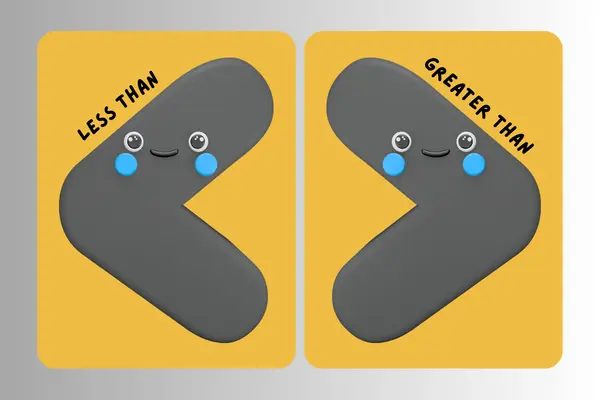
If you’ve ever stared at a math problem and wondered which way the arrow is supposed to point, you’re not alone. The greater than and less than sign trips up students, parents helping with homework, and even adults who haven’t touched a math worksheet in years. The good news is that once you understand the logic behind these symbols, you’ll never second guess them again.
In simple terms, the greater than sign (>) tells you that the number on the left is bigger than the number on the right. The less than sign (<) tells you the opposite, that the number on the left is smaller. For example, 5 > 2 means “5 is greater than 2,” and 2 < 5 means “2 is less than 5.” That’s really all there is to the basic idea. What usually causes confusion is remembering which symbol points which way, and that’s exactly what this guide is going to fix.
What Is the Greater Than and Less Than Symbol?
The greater than and less than symbols are part of a small family of math symbols called inequality symbols. Instead of saying two things are equal, like the equal sign does, these symbols show a relationship between two values that are not the same.
You’ll usually meet them for the first time in elementary school, right around the time you start comparing numbers instead of just adding and subtracting them. But they don’t stop being useful after that. You’ll see them again in algebra, in spreadsheets, in coding, and even in everyday situations like comparing prices or ages.
The core idea never changes. The symbol always opens toward the larger value and points toward the smaller one. Keep that one sentence in mind, because everything else in this guide builds on it.
Greater Than and Less Than Symbols Chart
Sometimes the fastest way to understand a symbol is to see it laid out clearly next to its meaning and an example. Here’s a full chart covering the greater than and less than sign along with the related symbols you’ll often see used alongside them.
| Symbol | Name | Meaning | Example |
| > | Greater than | The value on the left is larger | 8 > 3 |
| < | Less than | The value on the left is smaller | 3 < 8 |
| = | Equal to | Both values are the same | 4 = 4 |
| ≠ | Not equal to | The values are different | 5 ≠ 9 |
| ≥ | Greater than or equal to | The left value is larger or the same | 6 ≥ 6 |
| ≤ | Less than or equal to | The left value is smaller or the same | 2 ≤ 5 |
Once you have this chart in front of you, the symbols stop feeling abstract. You can literally see the pattern. The open side always faces the bigger number, and the narrow point always faces the smaller one.
Which One Is Greater Than and Which Is Less Than?
This is usually where people get stuck, and honestly, it makes sense. The two symbols are mirror images of each other, so your eyes have to do a bit of extra work to tell them apart.
Here’s the rule that solves it every time. Look at which side of the symbol is wide open and which side comes to a point. The wide open side always faces the bigger number. The pointed side always faces the smaller number.
Take a look at these two number sentences side by side.
7 > 3 reads as “7 is greater than 3”
3 < 7 reads as “3 is less than 7”
Notice that both sentences describe the exact same relationship between 7 and 3. The only thing that changes is which number comes first and which symbol you use to say it. Once you get comfortable flipping between these two ways of writing the same comparison, the confusion tends to disappear for good.
How to Remember Greater Than and Less Than (5 Easy Tricks)
If the rule above still feels a little abstract, that’s completely normal. Most people need a visual trick to make it stick, especially the first few times they use these symbols. Here are five different memory tricks. You don’t need to use all of them, just pick the one that clicks for you.
The Alligator (or Crocodile) Method
Picture the symbol as a hungry alligator’s mouth, with the numbers on either side acting like piles of fish. The alligator is greedy and always wants to eat the bigger pile, so its mouth opens toward the larger number every single time.
If you see 9 and 4, the alligator’s mouth opens toward the 9, giving you 9 > 4. This is probably the most popular trick taught in classrooms, and it works because it turns an abstract symbol into something you can actually picture in your head.
The “L” Method
Here’s a simple one. The word “less” starts with the letter L, and if you look closely at the less than sign, it actually resembles a sideways L. So whenever you see a symbol that looks like an L, you know it means “less than.”
The greater than sign doesn’t look anything like an L, which is your signal that it means the opposite.
The Open-Ended Method
This trick skips the animal imagery altogether and focuses purely on shape. The wide, open end of the symbol always faces the bigger value, while the narrow, pointed end always faces the smaller one.
Some people find this version easier because there’s nothing to memorize beyond one visual rule. Big number, wide opening. Small number, narrow point.
The Dot Method
Look closely at the greater than symbol and you’ll notice it has two points stacked on the left side and just one point on the right. The side with two points is the “greater” side. This trick works especially well for people who like counting and pattern recognition rather than storytelling.
The Music Method
If you’ve ever read sheet music, you may already know this one without realizing it. The greater than and less than symbols look almost identical to the crescendo and decrescendo marks that show music getting louder or quieter. In music, the symbol widens toward the louder section. In math, it widens toward the bigger number. Same shape, same logic, just a different context.
Greater Than and Less Than in Real Math
Once the basics feel comfortable, these symbols start showing up in slightly trickier situations. Here’s where people tend to slip up, along with the simple rules that keep you on track.
Comparing Decimals and Fractions
When comparing decimals, line up the digits by place value before deciding which symbol to use. For example, 0.75 > 0.5 because 75 hundredths is more than 50 hundredths, even though 0.5 looks shorter on the page.
Fractions work the same way once you convert them to a common form. Comparing 3/4 and 1/2 is much easier once you see them as 0.75 and 0.5.
Comparing Negative Numbers
This is the one that catches almost everyone off guard at least once. With negative numbers, the value closer to zero is actually the larger one. So -2 > -8, even though 8 looks like the bigger number at first glance. Picture a number line. The further left you go, the smaller the value gets, no matter how big the number looks without its negative sign.
Using the Signs in Algebra and Inequalities
In algebra, these symbols help define a range of possible values rather than a single answer. For example, x > 4 means x can be any number bigger than 4, not just one specific value.
There’s one important rule to remember here. If you multiply or divide both sides of an inequality by a negative number, the symbol flips direction. So if you start with x > 4 and multiply both sides by negative one, the x becomes negative, the 4 becomes -4, and the sign flips, giving you -x < -4. This single rule causes more mistakes in algebra homework than almost anything else, so it’s worth committing to memory early.
Greater Than and Less Than in Excel (COUNTIF Formula Guide)
The greater than and less than sign isn’t just for math class. If you work with spreadsheets, you’ll run into these symbols constantly, especially inside the COUNTIF function.
Let’s say you have a list of numbers in cells A1 through A10 and you want to count how many are above 50. You’d write it like this.
=COUNTIF(A1:A10,”>50″)
Want to count values below 50 instead? Just swap the symbol.
=COUNTIF(A1:A10,”<50″)
You can also compare against a value stored in another cell rather than typing a fixed number. This is handy when your threshold might change later.
=COUNTIF(A1:A10,”>”&B1)
Notice the quotation marks around the symbol and the ampersand connecting it to the cell reference. That small formatting detail trips people up more than the logic itself does, so it’s worth double checking whenever your formula isn’t returning the result you expect.
Common Mistakes When Using Greater Than and Less Than Signs
Even after learning the rules, a few mistakes tend to repeat themselves. Here are the ones worth watching for.
- Flipping the sign direction by accident, especially when numbers are written in a less familiar order
- Forgetting that negative numbers work backwards, where the smaller-looking number is often the larger value
- Mixing up greater than or equal to (≥) with plain greater than (>), which matters a lot in word problems and coding conditions
- Placing the sign incorrectly in written word problems, particularly when translating a sentence into a math expression
Most of these mistakes fade quickly once you slow down and picture the number line or the alligator’s mouth before writing the symbol down.
Frequently Asked Questions
What is the difference between greater than and less than?
Greater than (>) shows that the number on the left is larger than the number on the right, while less than (<) shows the opposite, that the number on the left is smaller. Both symbols describe the same type of relationship, just from opposite directions.
What does the greater than or equal to sign mean?
The greater than or equal to sign (≥) means the left value is either bigger than the right value or exactly equal to it. You’ll see this often in situations involving minimums, like “you must be 18 or older,” written as age ≥ 18.
How do you use greater than and less than symbols in a sentence?
Place the symbol between the two values you’re comparing, with the open side facing the larger number. For example, in “there are more than 10 apples,” you’d write apples > 10, since the count needs to be higher than ten.
What is the sign for greater than and less than?
The sign for greater than is (>) and the sign for less than is (<). They’re simple angled lines that always point toward the smaller value in the comparison.
Which one is greater than and less than?
The symbol that opens wide toward the bigger number is greater than, and the one that opens wide toward the smaller number, pointing away from the larger one, is less than. Looking at which side of the symbol is open usually settles the question fastest.
Why are greater than and less than symbols important in math?
They let you describe a relationship between numbers without needing them to be equal. This shows up constantly in real situations, from comparing prices and scores to setting rules in algebra, coding, and spreadsheets.
Bringing It All Together
The greater than and less than sign might look intimidating at first, but the logic behind it is genuinely simple once it clicks. The open side of the symbol always points toward the bigger number, and the narrow side always points toward the smaller one. Whether you picture a hungry alligator, a sideways letter L, or a crescendo mark from sheet music, the trick is choosing the memory device that actually sticks with you.
From basic number comparisons to decimals, negative numbers, algebra, and even Excel formulas, these two small symbols carry a lot of weight across math and everyday life. The more you practice writing them out, the less you’ll need to pause and think about which way they go.
Take a moment to try a few comparisons on your own, maybe with prices, ages, or test scores you already know. Write them out using > and <, and check yourself against the tricks above. Small, repeated practice like this is what makes the symbols second nature.
If you’re working on strengthening your grasp of tricky word pairs and symbols beyond math, it’s worth exploring related guides like Flier vs Flyer, Led vs Lead, or Principal vs Principle to keep building clarity across both language and numbers.