
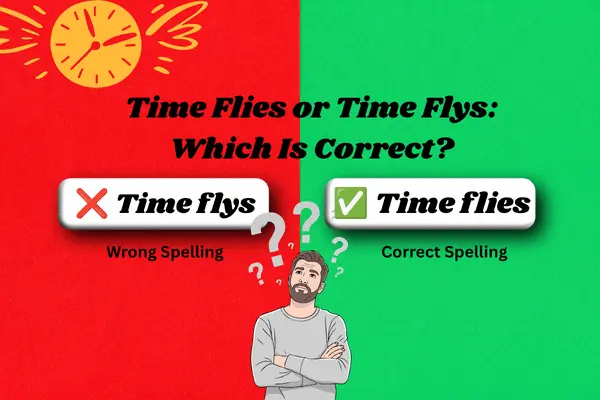
Time flies is correct. Time flys is not a real word, and it’s never acceptable, not even in a quick text or a casual caption. The verb you want is “flies,” the same third-person singular form you’d use for a bird, a plane, or an hour that seems to disappear the moment you stop watching the clock.
✅ Time flies ❌ Time flys
If you have ever paused before hitting send, wondering whether that little “y” needed to be “ies,” you’re in good company. This is one of the most commonly misspelled idioms in English, and the mix-up makes sense once you understand why it happens.
Is It “Time Flies” or “Time Flys”?
You’ve probably seen both spellings floating around online, which is exactly why the confusion sticks. Social posts, comment threads, and even some auto-generated captions get this wrong often enough that “time flys” starts to look almost normal. It isn’t. “Flies” is the only correct spelling, whether you’re writing a formal report, a birthday card, or a two-word reply to a friend.
Why “Time Flies” Is Always Correct
“Time” acts as a singular subject, and English pairs singular subjects with verbs that end in “s” or “es” in the present tense. “Fly” follows a specific spelling shift when it moves into that singular form, and that shift produces “flies,” never “flys.” Once you see the rule behind it, the spelling stops feeling arbitrary.
Why “Time Flys” Is Never Correct, Even Casually
Some people assume “flys” might be fine in relaxed writing, the way “gonna” slides by in a text. It doesn’t work that way here. “Flys” isn’t an informal version of anything. It’s simply a misspelling, and no context, platform, or tone makes it acceptable. The same trap catches people with alot and a lot, another pair that looks like it should follow the obvious pattern but actually doesn’t.
The Grammar Rule Behind “Flies” (Not “Flys”)
Here’s the part most people never actually learn, they just memorize the one phrase. Understanding the rule means you’ll never second-guess yourself again, on this word or the next one like it.
The Consonant + Y Rule
When a verb ends in a consonant followed by “y,” that “y” changes to “i” before you add “es” for the third-person singular form:
- cry → cries
- try → tries
- fry → fries
- dry → dries
- fly → flies
That’s the entire rule. No exceptions apply to “fly,” which is exactly why “flys” never had a real shot at being correct.
Why “Time” Takes a Singular Verb
Some writers wonder whether “time fly” might work instead, since dropping the “-ies” feels simpler. It doesn’t, because “time” is treated as one singular idea rather than a collection of separate moments. A singular subject needs a singular verb form, and that’s exactly why “flies” fits while plain “fly” doesn’t.
Does Autocorrect Catch “Flys”? What Spellcheckers and AI Tools Actually Flag
Most modern spellcheckers, including the tools built into phones, email clients, and AI writing assistants, flag “flys” right away, since it isn’t a recognized word in any standard dictionary. That said, autocorrect sometimes lets short, familiar-looking phrases slide through when you’re typing fast, which is part of why the mistake keeps showing up in casual writing more than you’d expect. It’s a similar quiet failure to what happens with principal vs principle, where spellcheck won’t save you because both words are technically real.
What Does “Time Flies” Mean?
The Idiom, Explained Simply
“Time flies” doesn’t involve literal flying. It’s a figure of speech that means time seems to move faster than expected, usually because you were busy, happy, or simply not paying attention to the clock. People say it after a great weekend, a long project that wrapped up in a blur, or a conversation that somehow turned into three hours.
Where the Phrase Comes From
The sentiment behind it is old. It traces back to a Latin phrase, tempus fugit, which roughly means time flees or time runs away. English speakers eventually shortened that idea into the version we use today. For the full dictionary definition, Merriam-Webster’s entry lays it out clearly.
Time Flies, Time Flew, Time Has Flown: The Full Tense Set
The phrase changes shape depending on when you’re talking about, and getting the tense wrong is its own small trap.
| Tense | Form | Example |
| Present | Time flies | Time flies during finals week. |
| Past | Time flew | Time flew during our trip to Portugal. |
| Present perfect | Time has flown | Time has flown since we moved into this house. |
Questions and negatives drop the “-ies” entirely, since the helping verb carries the tense instead: “Does time fly when you’re bored too, or only when you’re having fun?”
“How Time Flies” and Other Everyday Variations
“How Fast Time Flies”
This version usually shows up as a reaction, not a plain statement. “How fast time flies, I swear you were just starting college.”
“Crazy How Time Flies”
Same idea, more casual delivery. “Crazy how time flies, we’ve been in this apartment for five years already.”
“Time Flies When You’re Having Fun”: The Full Saying
This is the version most people actually say out loud. It adds a reason to the idiom instead of leaving it as a bare observation, and it spells exactly the same way as the shorter form. Whether you write “time flies when you’re having fun” or just “time flies,” the verb never changes.
How to Use “Time Flies” in Real Life
In an Email
“Sorry for the slow reply, time flies once the quarter gets busy. Thanks for your patience.”
In a Birthday Card or Social Caption
“Happy 30th! Time flies, and somehow you just keep getting better with it.”
In Everyday Conversation
“Wait, it’s already 9pm? Time flies when the food’s this good.”
In Formal or Professional Writing
“As the project neared its final phase, it became clear how quickly time flies under a tight deadline.”
Don’t Confuse “Flys” With These Look-Alikes
“Flys” vs “Fly’s” (Possessive)
These look nearly identical, but they mean completely different things. “Fly’s” is possessive, as in “the fly’s wings,” referring to something belonging to an actual insect. “Flys” isn’t a word at all, in either the possessive or plain form, so if you’re tempted to add that apostrophe, check whether you actually mean “fly’s” before you type it.
“Flys” vs “Flysch” (a Real Geology Term)
Here’s a genuine curveball. “Flysch” is a real word, it describes a sequence of sedimentary rock layers formed from erosion, most famously studied in the Alps. It has nothing to do with time, insects, or flying, but the visual similarity to “flys” is close enough to cause a double-take if you ever run into it in a geology textbook.
Wait, Was “Flys” Ever a Real Word?
Here’s a twist most grammar guides skip entirely. Centuries ago in England, a “fly” referred to a light, horse-drawn carriage, the kind of transport you’d hire for a short trip around town. In that older context, the plural really was spelled “flys.” That usage faded out along with the carriages themselves, so if you write “flys” today, you’re not using an outdated but valid word. You’re just making the same modern spelling mistake everyone else makes, minus the horse.
How Often Do People Actually Get This Wrong?
Rather than throw out a made-up percentage, it’s worth checking the real tools built for exactly this question. Google Ngram Viewer tracks how often phrases appear across millions of published books, and running “time flies” against “time flys” there shows the correct spelling dominating by an overwhelming margin, consistently, across decades. Google Trends tells a similar story for search behavior today. You can check both yourself in a few seconds, which honestly says more than any single statistic could.
British English vs American English: Any Difference?
Unlike word pairs such as learnt or learned, where British and American English genuinely diverge, “time flies” has no regional variation at all.
| Region | Correct Form | Notes |
| American English | Time flies | Standard, no variation |
| British English | Time flies | Standard, no variation |
If you’re writing for a UK, US, or Canadian audience, the spelling never changes. That’s one less thing to worry about.
Common Mistakes to Avoid
- ❌ Time flys → ✅ Time flies
- ❌ Time fly’s (adding an unnecessary apostrophe) → ✅ Time flies
- ❌ Times flies (treating “time” as plural) → ✅ Time flies
- ❌ Time fly (dropping the “-ies” entirely) → ✅ Time flies
These small slips are easy to make under the same conditions that trip people up with led vs lead, where the correct spelling depends on tense and part of speech rather than instinct.
Frequently Asked Questions
Is it time flies or time flys?
Time flies is correct. Time flys is a misspelling and is never grammatically acceptable.
Which is correct: time flies or time flys?
Time flies. It’s the standard spelling in both American and British English, with no exceptions.
Do you say time flies or time flys?
You say and write “time flies.” The pronunciation sounds similar to “flys,” which is exactly why the misspelling is so common.
What does time flies mean?
It means time seems to pass more quickly than expected, usually said when someone realizes how much time has gone by without noticing.
Why is time flies correct?
Because “fly” follows the standard consonant-plus-y spelling rule, changing to “flies” in the third-person singular present tense, matching the singular subject “time.”
Is time flys ever correct?
No. “Flys” isn’t a recognized word in modern English in any context, tense, or region.
How do you spell time flies?
T-I-M-E, F-L-I-E-S. The most common mistake is writing “flys” instead of “flies.”
What is the grammar rule behind time flies?
Verbs ending in a consonant plus “y” change the “y” to “i” and add “es” in the third-person singular present tense, which is why “fly” becomes “flies.”
What is the difference between flies and flys?
“Flies” is the only correct spelling, whether you’re using it as a verb or as the plural of the insect. “Flys” isn’t standard modern English at all.
Key Takeaway
Time flies is the only correct way to write this phrase, in every tense, every region, and every level of formality. The rule behind it is simple once you see it: a consonant-plus-y verb like “fly” always shifts to “ies” in the singular present tense, the same pattern you’ll find in “cry,” “try,” and “dry.” Skip “flys” entirely, and if word pairs like this tend to trip you up, it’s worth spending a few minutes with related mix-ups like alot and a lot or principal vs principle while you’re at it. A few minutes now saves you the second-guessing later.