
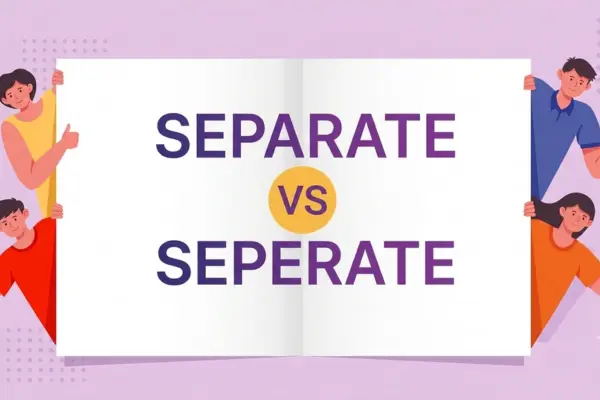
If you have ever paused mid sentence and stared at the word separate, wondering if it needs an A or an E in the middle, you are not alone. It is one of the most commonly misspelled words in English, and the confusion between separate vs seperate shows up everywhere from text messages to formal business reports. The good news is that once you understand why this mix up happens, you will never second guess it again.
Is It “Separate” or “Seperate”? The Quick Answer
Separate is the correct spelling. Seperate is simply a misspelling and it does not appear in any English dictionary. So if you have been asking yourself whether it is seperate or separate, the answer is always separate, whether you are writing an email, a school essay, or a quick text to a friend.
This applies no matter how the word is being used in the sentence. There is no version of English, formal or casual, American or British, where seperate becomes acceptable.
What Does “Separate” Mean?
Before locking in the spelling, it helps to understand what the word actually does in a sentence. Separate can function as a verb, an adjective, or occasionally a noun, and the meaning shifts slightly depending on which role it plays.
As a Verb
When separate works as a verb, it means to divide, split, or keep things apart. For example, “Please separate the recycling from the regular trash” or “The teacher asked the students to separate into small groups.” Related forms like separates, separated, and separating all follow this same action based meaning.
As an Adjective
As an adjective, separate describes something that is distinct, independent, or not joined to something else. “They keep separate bank accounts” or “We took separate cars to the event” are both good examples. Here the word is describing a state rather than an action.
As a Noun (Rare Use)
Less commonly, separate can act as a noun referring to individual clothing pieces that can be mixed and matched, like a blouse or skirt sold as a “separate.” This usage is rare in everyday writing, but it is worth knowing it exists.
Why Is “Seperate” Always Wrong?
A lot of people assume seperate might be a regional variation, an old spelling, or at least a word with some kind of niche meaning. It is not. Is seperate a word? No. It carries no definition of its own in any standard dictionary, including Merriam Webster and the Oxford English Dictionary. It is not slang, it is not informal shorthand, and it is not a British alternative. It is simply an error that happens because of how the word sounds when spoken.
Knowing this takes the guesswork out completely. There is no context, formal or casual, where seperate is the right call.
Separate vs Seperate: Spelling Breakdown
The easiest way to see the difference is to look at the vowels side by side.
| Spelling | Vowel Pattern | Correct? |
| separate | e-a-a-e | Yes |
| seperate | e-e-a-e | No |
Notice that correct spelling always keeps two A’s in the middle of the word, separated by an R. The moment you swap that first A for an E, the word breaks down and stops being a real English word. This small detail is really the entire mistake in a nutshell.
Why Do So Many People Misspell Separate?
Here is something that might make you feel better about mixing this one up in the past. The reason so many writers default to seperate has almost nothing to do with carelessness and everything to do with pronunciation.
When most people say separate out loud, especially in casual speech, that middle vowel gets swallowed into a soft “uh” sound. Linguists call this a schwa, and it is the same reason words like definitely and calendar trip people up too. Since that middle sound is unclear, your brain reaches for the letter that seems to match, and E often feels like the natural guess even though A is correct.
There is also a visual trap at play. The word desperate looks and sounds structurally similar to separate, but desperate is spelled with an E in that same position. Your brain sometimes borrows the pattern from one word and misapplies it to the other, which only adds to the confusion.
Where Does “Separate” Come From?
Understanding the word’s roots can also make the spelling click into place. Separate comes from the Latin word separare, a combination of se, meaning apart, and parare, meaning to prepare. That same “parare” root shows up in other familiar English words like prepare and repair, both of which also use an A in that position. Once you see the family resemblance, the A in separate starts to feel a lot less random.
Easy Tricks to Remember the Spelling
If you want a shortcut that sticks, these memory tricks work well for readers of every age.
- There’s a rat in sep-a-RAT-e. Picture an actual rat hiding in the middle of the word. It is a strange image, but strange images tend to stay in memory longer than plain rules.
- Symmetrical vowels. The correct spelling reads e-a-a-e from front to back, which is a mirrored, symmetrical pattern. The incorrect version breaks that symmetry.
- Match it to “automatic.” Both separate and automatic contain two A’s, so if your spelling of separate feels automatic, it is probably right.
Pick whichever trick feels most natural and it should carry you through the rest of your writing life without a second thought.
Separated, Separately, Separation: Same Rule Applies
The confusion does not stop at the base word. Every related form follows the exact same pattern, which means once you learn one, you have essentially learned them all.
| Correct | Incorrect | Part of Speech |
| separated | seperated | past tense verb / adjective |
| separately | seperately | adverb |
| separation | seperation | noun |
So if you were wondering about separated vs seperated or separation vs seperation, the rule is identical. Keep the A, drop the E, every single time.
Is “Seperate” a British Spelling?
This is one of the more persistent myths out there, so it is worth addressing directly. Is seperate a British spelling? No. Unlike genuine American versus British spelling differences, such as color and colour or organize and organise, separate is spelled exactly the same way in both American and British English. There is no dialect, region, or English speaking country where seperate becomes the accepted form. If you are writing for a UK audience, an American audience, or anyone in between, the correct spelling never changes.
Separate vs Desperate: Don’t Mix These Up
Since these two words often get tangled together, it helps to see them side by side. Separate uses the pattern A-R-A, while desperate uses E-R-A. They come from different Latin roots entirely, separare for separate and desperare for desperate, which explains why the middle vowels differ even though the words rhyme when spoken.
Separate vs Segregate vs Split
These three words share some overlap in meaning, but they are not interchangeable. Separate is the most neutral and widely used, simply meaning to divide or keep apart. Segregate carries a stronger, often more formal or systemic implication, such as separating groups based on a specific category. Split tends to suggest dividing something into smaller pieces or portions, like splitting a bill or splitting the difference. Choosing the right one depends on the tone and precision your sentence needs.
“Separate” in Real Sentences
Seeing the word used across different settings makes the correct spelling feel far more natural.
In a business email: “Please find the invoice attached as a separate document for your records.”
In academic writing: “The study examined each variable separately to isolate its individual effect on the results.”
In everyday conversation: “We decided to take separate cars in case one of us needs to leave early.”
In British English: “The company operates two separate branches, one in London and one in Manchester.”
In casual texting: “Can you send that in a separate message so I don’t lose it in the thread?”
Across every one of these examples, from English grammar in formal writing to relaxed everyday English, the spelling never bends.
Synonyms for “Separate”
If you want to vary your word choice while keeping the same idea, these alternatives work well depending on context.
As a verb: detach, disconnect, divide, part, split.
As an adjective: distinct, independent, individual, disconnected, apart.
Swapping in a synonym can also be a useful trick when you are unsure of the spelling mid sentence and want to sidestep the issue entirely while you double check.
FAQs
Is it separate or seperate?
Separate is always correct. Seperate is a common spelling mistake with no accepted meaning in English.
Why is seperate considered wrong?
Because it does not follow the correct vowel pattern of the Latin root separare, and no dictionary or style guide recognizes it as valid.
Why do people confuse separate and seperate?
Mostly because of pronunciation. The middle vowel sound in separate is soft and unclear when spoken, which makes E feel like a reasonable guess even though A is correct.
Can spelling mistakes like this affect professional writing?
Yes. A small error like seperate can quietly undercut your credibility in emails, reports, and other professional documents, even if the rest of your writing is strong.
What is a good way to remember the correct spelling?
Try picturing a rat hiding inside the word, sep-a-RAT-e. It is a small trick, but it tends to stick.
Final Thoughts
At the end of the day, the difference between separate vs seperate comes down to one simple fact: separate is correct, and seperate is not a word at all. It does not matter whether you are drafting a professional email, finishing a school assignment, writing a text to a friend, or posting something on social media, the spelling stays the same every time.
What makes this word tricky is not carelessness on your part. It is the way English handles unstressed vowels, combined with a lookalike word like desperate that pulls your instincts in the wrong direction. Once you understand that reasoning, the mistake tends to fade on its own.
If you want it to stick for good, lean on one of the memory tricks from earlier, whether that is picturing the rat hidden in the middle of the word or remembering the mirrored e-a-a-e vowel pattern. Small habits like this add up over time, and they show up in how polished and trustworthy your writing feels to other people.
Spelling is one of those quiet signals readers pick up on without even realizing it. Getting words like separate right, along with other tricky pairs like alot and a lot or benefited or benefitted, builds a kind of quiet trust with your reader. It tells them you care about the details, which matters just as much in a two line text as it does in a formal report.
If commonly confused words like this trip you up often, it is worth spending a little time with related guides like led vs lead, principal vs principle, or objective vs subjective. A little practice with these goes a long way toward writing with more confidence, no matter what you are working on.