
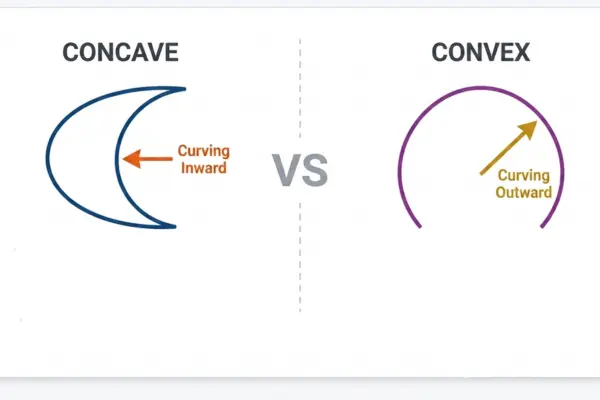
If you’ve ever paused halfway through a sentence wondering about concave vs convex, you’re in good company. These two words look almost like mirror images of each other, and that’s fitting, because their meanings work the same way. Concave describes something that curves inward, like the inside of a bowl. Convex describes something that curves outward, like the outside of that same bowl. Once you see the difference in one real object, it rarely trips you up again. This guide walks through the core meaning, an easy way to remember which is which, and how the two words show up everywhere from geometry class to your car’s side mirror.
Quick answer: Concave curves inward, like a cave. Convex curves outward, like a dome. If a shape or surface bends toward you, it’s concave. If it bends away from you, it’s convex. That one rule works for shapes, mirrors, lenses, and even graphs.
Concave vs Convex at a Glance
Here’s the whole comparison in one place before we go deeper into each context.
| Feature | Concave | Convex |
| Curve direction | Inward | Outward |
| Feels like | The inside of a cave or bowl | The outside of a dome or ball |
| Simple example | A spoon’s scooping side | A spoon’s back side |
| In geometry | A polygon with an angle over 180 degrees | A polygon with no angle over 180 degrees |
| In optics | Spreads light rays apart | Usually brings light rays together |
| Easy memory trick | Has the word “cave” inside it | Curves the opposite way from concave |
What Is Concave? What Is Convex? (The Core Difference)
At its simplest, concave means curving inward or hollowed out, the way a cave dips into a mountainside. Think about the inside of a mixing bowl. Your finger traces a line that dips down and away from you. That inward dip is concave.
Convex works the opposite way. It means curving outward or bulging, the way a hill rises from flat ground. Flip that same bowl over and run your finger along the outside. Now the surface pushes up toward you instead of dipping away. That outward bulge is convex.
A helpful way to hold onto both definitions at once is to picture a single curved line. Look at it from one side and it looks concave. Walk around to the other side and the exact same line now looks convex. Neither word describes an object on its own. Both describe which way a surface bends relative to where you’re standing.
How to Remember Concave vs Convex (The Easiest Trick)
The fastest trick is hiding right inside the word itself. Concave contains the word “cave,” and a cave is hollow and curves inward, exactly like the shape it’s describing. Say the word out loud and picture walking into a cave. That image sticks.
Convex doesn’t have as obvious a hint, so try this instead. Convex sounds close to “vex,” and something vexing pushes outward at you, like a problem that won’t stay contained. Or picture the letter C. A concave shape curves the same direction as the letter C, opening inward toward you. Convex does the reverse.
Either trick works on its own. Use whichever one sticks in your head, because the goal isn’t memorizing a rule. It’s being able to glance at a curved surface and know instantly which word fits.
Concave vs Convex Shapes: Real-World Examples
Once the definitions click, spotting concave and convex shapes around you becomes almost automatic.
Concave shapes and surfaces include:
- The inside of a bowl or spoon
- A satellite dish
- The opening of a megaphone
- A crescent moon
- The inside of a tunnel or cave entrance
- A funnel
Convex shapes and surfaces include:
- The outside of a ball, egg, or dome
- A football or rugby ball
- The back of a spoon
- A doorknob
- A car’s rounded hood
- The outer shell of a helmet
A single object often shows both. A bowl is concave on the inside where your soup sits and convex on the outside where it rests on the table. A spoon works the same way. That’s not a contradiction. It just means concave and convex describe a direction of curve, not a fixed label stuck to one object forever.
Concave vs Convex in Geometry and Math: Polygons Explained
Geometry gives concave and convex a more exact meaning than everyday language does. A polygon is convex if every interior angle measures 180 degrees or less, meaning none of its corners point inward. Squares, triangles, and regular hexagons are all convex polygons because every angle stays open and none of the sides cave in on themselves.
A polygon is concave if at least one interior angle is greater than 180 degrees, creating a corner that points inward. A classic five-pointed star is a concave polygon for exactly this reason. Each point of the star creates an inward dent where two edges meet.
An easy visual test works even without measuring angles. Draw a straight line between any two points inside a convex shape, and that line stays fully inside the shape. Try the same test on a concave shape, like the star, and the line will cross outside the shape’s edges at some point.
This inward-pointing property is also why mathematicians use the noun concavity to describe how sharply or gently a shape curves, a term that carries over directly into graphs and functions, which is where things get interesting next.
Concave vs Convex Function, Curve, and Graph
This is where concave and convex stop describing physical objects and start describing the shape of a graph, and it’s an area most explanations skip entirely.
Picture a graph shaped like a smile, a curve that dips down in the middle and rises on both ends. That’s a convex curve, sometimes called concave up. If you draw a straight line connecting any two points on that curve, the line sits above the curve.
Now picture a graph shaped like a frown, rising in the middle and falling on both ends. That’s a concave curve, sometimes called concave down. Draw the same straight line test, and this time the line sits below the curve.
This distinction matters far beyond a math classroom. Economists use convex and concave curves to describe cost, risk, and returns. Engineers rely on the same idea when designing anything that needs a predictable curve, from bridges to lenses. Even the greater than and less than symbols you learned early on point in a direction, which is a useful bridge into thinking about curves the same visual way.
You don’t need calculus to use this correctly in conversation. Just remember that convex bends like a cup holding water, and concave bends like an upside down cup spilling it out.
Concave vs Convex in Lenses and Mirrors (Quick Overview)
Concave and convex show up constantly in optics too, though each topic deserves its own deeper guide. Here’s the short version.
Concave and Convex Lenses
A convex lens bulges outward and bends light rays inward toward a single focus point. This is why magnifying glasses and glasses for farsightedness use convex lenses, they concentrate light to make things appear bigger or bring nearby objects into focus. A concave lens curves inward and spreads light rays apart instead of gathering them, which is why it’s used to correct nearsightedness.
Concave and Convex Mirrors
A concave mirror curves inward and can make reflections look larger up close, the same effect used in makeup and shaving mirrors. A convex mirror curves outward and reflects a wider area at a smaller size, which is exactly why your car’s passenger side mirror is convex. It trades image size for a wider field of view.
Is “Concave” or “Convex” a Noun or an Adjective? (Grammar Breakdown)
Both concave and convex are most commonly used as adjectives, describing a noun’s shape. You’ll see them paired with words like lens, mirror, surface, or polygon.
Concave can also function as a noun in technical writing, referring to a curved line or surface itself, though this usage is rare outside geometry and optics. Convex almost never works as a noun on its own. Instead, English relies on the word convexity to name the property of curving outward, just as concavity names the property of curving inward.
If you’re the kind of writer who likes getting word usage exactly right, this pairs nicely with other commonly confused terms, like principal vs. principle or objective vs. subjective, where a small distinction changes the whole meaning of a sentence.
Where Do the Words “Concave” and “Convex” Come From?
Concave traces back to the Latin word concavus, built from cavus, meaning hollow, the same root that gives English the word cave. That shared origin is exactly why the cave trick works so well as a memory aid.
Convex comes from the Latin convexus, meaning vaulted or arched. Both words entered English centuries ago, and neither meaning has shifted much since, which is part of why they still show up unchanged in modern geometry, science, and design vocabulary today.
FAQs About Concave vs Convex
Is a bowl concave or convex?
A bowl is both, depending on which side you’re looking at. The inside, where food sits, curves inward and is concave. The outside, which touches the table, curves outward and is convex. This is true of most curved household objects, not just bowls.
How do you know if something is concave or convex?
Check which way the surface bends relative to you. If it curves away from you to create a hollow center like a cave, it’s concave. If it arches or bulges toward you like a dome or a ball, it’s convex. This works for shapes, mirrors, and lenses alike.
Can a shape be both concave and convex?
Yes, in a sense. A single continuous curve, like a semicircle, can look concave from one side and convex from the other. What changes isn’t the shape itself, but the direction you’re viewing it from.
What is a concave lens used for?
A concave lens spreads light rays apart instead of pulling them together, which is why it corrects nearsightedness and shows up in devices like binoculars and peepholes.
What is a convex mirror used for?
A convex mirror curves outward and reflects a wider area than a flat mirror, though objects appear smaller and farther away than they really are. That’s exactly why car side mirrors and store security mirrors are almost always convex.
What’s the easiest way to remember concave vs convex?
Remember that concave has the word cave inside it, and a cave curves inward. Convex does the opposite. If one trick doesn’t stick, try picturing the letter C for concave, since it opens inward the same way the shape does.
Conclusion
Concave and convex are two of those word pairs that seem confusing right up until you find one clear example, and then they never confuse you again. The rule stays the same everywhere you find these words. Concave curves inward, like the inside of a cave, a bowl, or a satellite dish. Convex curves outward, like the outside of a dome, a football, or your car’s side mirror.
That single direction of curve carries through every context covered here. In geometry, it decides whether a polygon has an inward-pointing corner or not. In optics, it decides whether a lens gathers light into a focus point or spreads it apart, and whether a mirror magnifies what’s close or widens what’s visible. On a graph, it decides whether a curve bends like a smile holding water or a frown spilling it out. Different fields, same underlying idea.
If you only remember one thing from this guide, let it be the cave trick. Concave has “cave” built right into it, and a cave curves inward. Everything else, including convex, follows from knowing that one word by contrast.
Understanding concave and convex isn’t just a vocabulary exercise either. These two words describe how light bends in the glasses you wear, why your car’s mirror shows a wider view than what’s actually behind you, and why a small shift in a cost graph can mean the difference between rising profit and rising risk. Once you can spot the difference on sight, in a shape, a lens, a mirror, or a graph, you won’t be slowed down by it again.
For more of these easy-to-mix-up word pairs, our guides on led vs lead and flier vs flyer cover the same kind of quick, practical distinction that makes everyday writing and reading a little clearer.