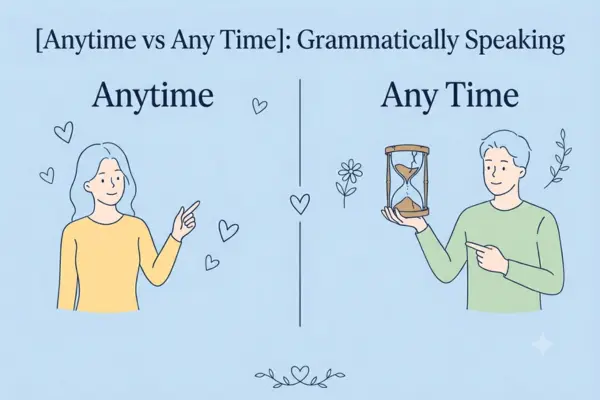
Quick answer: Use anytime (one word) when you mean “whenever,” as in “Call me anytime.” Use any time (two words) when you’re talking about an amount of time, or right after a word like “at,” as in “I don’t have any time” or “You can call at any time.” If you’re ever unsure, “any time” is the safer, more formal choice.
You’ve probably typed both versions in the same message before catching yourself. You text a friend “come over anytime this weekend,” then five minutes later you write in a work email “let me know if you have any time to review this,” and something about the second one makes you pause. Is that supposed to be one word too? It isn’t, and once you understand why, you’ll never have to guess again.
The confusion between anytime vs any time is one of the most common small grammar snags in English, right up there with mixing up “its” and “it’s.” The good news is that the rule behind it is genuinely simple once someone walks you through it properly, and that’s exactly what this guide does.
Anytime vs Any Time: Quick Comparison Table
Before we get into the grammar behind it, here’s a side-by-side look at how each form actually behaves in a sentence.
| Anytime | Any Time | |
| Part of speech | Adverb (or subordinating conjunction) | Noun phrase |
| Meaning | Whenever | An amount of time |
| Can follow “at”? | No | Yes (“at any time”) |
| Example | Call me anytime. | I don’t have any time today. |
| Formality | Slightly informal | Neutral to formal |
This table alone answers most of what people search for around anytime vs any time meaning, but the details matter, so let’s break each one down properly.
What Does “Anytime” Mean?
Anytime, written as a single word, is an adverb. It means “whenever” or “at any moment,” and like any other adverb, its job is to describe when an action happens.
- I’m free anytime after 5 PM.
- You can text me anytime.
- Feel free to stop by anytime you’re in the neighborhood.
Notice how in each of these, you could swap in the word “whenever” and the sentence would still make perfect sense. That substitution test is actually one of the easiest ways to check whether anytime is the correct choice, and we’ll come back to it later in this article.
Anytime can also work as a subordinating conjunction, which just means it can introduce a clause that depends on the rest of the sentence.
- Anytime you need help, just ask.
- Anytime the power goes out, the backup generator kicks in.
What Does “Any Time” Mean?
Any time, written as two separate words, functions as a noun phrase. Here, “any” is simply modifying the noun “time,” the same way it would modify any other noun, like “any money” or “any patience.”
- I don’t have any time to spare this week.
- Do you have any time free on Thursday?
- We didn’t waste any time getting started.
In each case, “time” is being treated as a quantity, something you either have or don’t have, rather than describing when something happens. This is the core distinction that separates it from anytime.
Anytime vs Any Time: Grammar Rules
Here’s where the two forms really diverge, and where most of the confusion tends to disappear once it clicks.
Rule 1: After a preposition, always use “any time.”
If the word “at” (or a similar preposition) comes right before it, it has to be two words. “At any time” is correct. “At anytime” is not, and you’ll see this mistake more often than you’d expect, even in professional writing.
- Correct: You may cancel your subscription at any time.
- Incorrect: You may cancel your subscription at anytime.
Rule 2: When referring to a quantity of time, use “any time.”
Anywhere you could substitute “time” with another noun like “money” or “energy” and the sentence still makes sense, you need the two-word form.
- I don’t have any time left. (I don’t have any money left.)
Rule 3: When describing “whenever,” either form technically works, but “anytime” is more common and natural in everyday writing.
- Call me anytime.
- Call me any time.
Both are grammatically acceptable here, though anytime feels more natural in casual and modern usage, which is exactly why it’s become the default in texts, emails, and everyday conversation.
When to Use Anytime vs Any Time (Usage Guide)
If you want a practical, no-overthinking way to decide, run through these three quick questions.
- Is there a preposition like “at” right before it? If yes, it’s any time, no exceptions.
- Could you replace it with “whenever” and keep the same meaning? If yes, anytime works.
- Are you talking about an amount of time you have, need, or don’t have? If yes, it’s any time.
This is genuinely the fastest way to check your own writing, whether you’re drafting a quick text or proofreading a formal report. If you’re still unsure after running through those three questions, defaulting to any time is always the safer bet, since the two-word form is never grammatically wrong, even in the spots where anytime would also be acceptable.
Anytime vs Any Time in a Sentence (Examples)
Seeing both forms across a range of real, everyday contexts tends to make the rule click faster than any explanation alone.
Anytime used correctly:
- The store is open anytime between 9 AM and 9 PM.
- You’re welcome to visit anytime.
- Drop off the package anytime this week.
- Anytime she calls, I answer.
Any time used correctly:
- I appreciate you giving me any time at all.
- The meeting could get moved up at any time.
- We need any time slot that works for the client.
- I haven’t had any time to relax lately.
In professional and business writing especially, this distinction shows up constantly, in scheduling emails, customer service replies, and internal memos. Getting it right is a small detail, but small details are often what separate polished writing from writing that just looks slightly off.
“Call Me Anytime” vs “Call Me Any Time”
This exact phrase deserves its own quick mention because it’s one of the most searched examples of this whole topic, and it’s also one of the more forgiving cases.
“Call me anytime” is by far the more common version, and it’s the one you’ll see in texts, casual emails, and everyday speech. “Call me any time” isn’t wrong, it’s just more formal and a little less common. If you’re writing something casual, go with anytime. If you’re writing something more buttoned-up, like a formal letter or an official notice, any time reads slightly more polished.
Anytime vs Any Time: US vs UK English
Here’s a detail that most grammar guides skip entirely, but it genuinely matters if you write for a British audience or work with UK-based clients.
American English tends to favor the single-word anytime far more heavily in everyday writing, including in marketing copy, apps, and casual business communication. British English, on the other hand, leans more often toward the two-word any time, especially in formal and journalistic contexts, though anytime has become increasingly common in casual British writing too, largely thanks to American media influence.
If you’re writing for a UK audience and want to sound naturally native rather than Americanized, defaulting to any time in more formal contexts is generally the safer, more traditional choice.
AP Style and Chicago Manual of Style: Which Is Correct?
If you write professionally, whether that’s journalism, corporate communication, or academic work, you’ve probably had to check a style guide for smaller details like this one.
AP Style generally treats anytime as an acceptable single word when used as an adverb meaning “whenever,” reflecting how the term is used in modern American journalism and everyday writing.
The Chicago Manual of Style takes a similarly practical approach, allowing anytime as a legitimate adverb in contemporary usage while still recognizing any time as the standard two-word noun phrase in its traditional sense.
In short, neither major style guide considers anytime incorrect anymore. The real distinction both guides care about is the same one covered above, whether you’re using it as an adverb meaning “whenever” or as a noun phrase describing an amount of time.
Quick Trick to Never Get It Wrong Again
If you only remember one thing from this entire article, make it this. Try replacing the word with “whenever.” If the sentence still makes complete sense, use anytime. If it sounds off or nonsensical, use any time.
“Call me whenever” makes sense, so anytime is correct. “I don’t have whenever” doesn’t make sense, so any time is correct.
This one trick solves almost every situation you’ll ever run into with this word pair.
FAQs
Is “anytime” one word or two?
Both forms exist and are correct, depending on the context. Anytime as one word is an adverb meaning “whenever.” Any time as two words is a noun phrase referring to an amount of time.
Is “at anytime” correct?
No. When a preposition like “at” comes before it, the correct form is always the two-word any time, as in “at any time.”
What is a synonym for anytime?
Common synonyms include “whenever,” “at any time,” and “on any occasion.” All three can generally be swapped in for anytime without changing the meaning of the sentence.
Can I use anytime in a sentence like “call me anytime”?
Yes, this is one of the most common and correct uses of anytime, functioning as an adverb meaning “whenever you’d like.”
Is anytime formal or informal?
Anytime is considered slightly informal, so many style guides recommend using “whenever” or the two-word any time in more formal or academic writing.
Conclusion
Getting anytime vs any time right really comes down to one simple question: are you describing when something happens, or how much time you have? Anytime works as an adverb meaning “whenever,” while any time functions as a noun phrase describing an amount of time, especially right after words like “at.” Once that distinction is clear, the rest falls into place naturally, whether you’re texting a friend, writing a client email, or polishing a formal report.
Small grammar details like this one might feel minor, but they add up. Writing that gets these little things right reads as more careful, more professional, and more confident, even if the reader can’t quite explain why. The next time you catch yourself pausing mid-sentence over this exact word pair, run through the “whenever” substitution trick, and you’ll have your answer in seconds.
If you found this useful, you might also want to look into other commonly confused word pairs that trip up even experienced writers, like led vs lead or principal vs principle, both of which follow the same pattern of a small spelling or spacing difference carrying real grammatical weight. Mastering these details, one pair at a time, is what quietly separates good writing from writing that simply sounds right.