Flier vs Flyer. You are writing an email about Saturday’s fundraiser, or maybe designing a handout for your shop’s grand opening, and you stop halfway through a sentence. Is it a flyer or a flier? Autocorrect doesn’t flag either one, which somehow makes the moment worse instead of better.
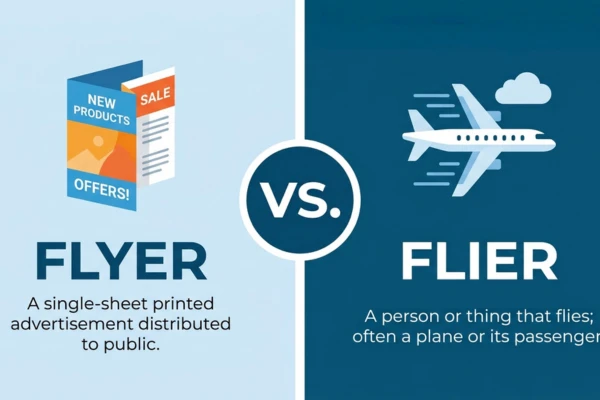
Here’s the short version. If you mean the piece of paper people hand out on the street, you want flyer. If you mean a person, animal, or object that flies, flier is the more traditional choice, though flyer works there too these days. Both spellings are real, both show up in respected writing, and the confusion makes total sense because English genuinely hasn’t settled this one.
Below, we’ll walk through where each spelling comes from, what the major dictionaries and style guides actually say, and how to pick your spelling with confidence no matter what you’re writing.
What Do Flier and Flyer Actually Mean
At their core, flier and flyer are the same word wearing two different spellings. Most dictionaries treat them as variants of a single entry rather than as two separate words with two separate meanings, which is exactly why so many writers assume they’re interchangeable. In a lot of everyday writing, they basically are.
The word covers more ground than people expect. It can describe a printed advertisement, the kind you’d find taped to a lamppost or tucked under a windshield wiper. It can describe a person who flies, like a pilot or a seasoned airline passenger. Older usage also covered things like a fast train or a bird known for strong, confident flight. A couple of niche, technical meanings still hang around too, and we’ll get to those later.
The spelling doesn’t change any of these meanings. What changes is which spelling readers expect to see in which context, and that expectation comes from decades of publishing habits rather than one clean rule.
Why Are There Two Spellings in the First Place
The two spellings aren’t random. Flyer is actually the older, more original form. Flier came about because English has a habit of swapping a final y for an i when a suffix gets added, the same pattern you see when busy becomes busiest, try becomes tries, and fly becomes flies. At some point, that same instinct got applied to this word, and flier emerged as an Americanized variant.
It doesn’t happen with every y-ending word though. When a vowel sits right before the y, English usually leaves it alone. Play stays play in playing, stay stays stay in stays, and toy stays toy in toyed. Flyer sits right on the edge of that pattern, which is a big part of why even careful, experienced writers hesitate over it.
Knowing this backstory won’t settle the argument for you on its own, but it does explain why the disagreement exists at all, and why neither spelling is actually wrong.
Flier vs Flyer, The Real Difference
When to Use Flyer for Paper
If you’re talking about a piece of paper made to catch someone’s attention, flyer is the spelling nearly everyone expects today. Marketing handouts, event announcements, missing pet notices, yard sale signs, community bulletin board postings, all of these are flyers in the vast majority of American and British writing. Handbill, circular, and leaflet describe roughly the same object, but flyer is what most people actually say and type.
A local bakery announcing its grand opening will print flyers. A band promoting a weekend show will hand out flyers. A school parent group reminding families about a fundraiser will post flyers around the building. This is the meaning where flyer has genuinely pulled ahead as the expected choice, no matter which side of the Atlantic you’re writing from.
When to Use Flier for Things That Fly
Flier holds its ground mainly in one specific area, describing a person, animal, or object that flies. A confident airline passenger, a skilled pilot, a bird known for long migrations, a small private aircraft. Traditional style guides have leaned toward flier here, though flyer is accepted in this context too and has steadily gained ground over the years.
This is also where a few set phrases behave a little differently from the general pattern, which we’ll dig into further down.
What Do Dictionaries and Style Guides Say
Here’s where things get genuinely interesting, because the authorities don’t all agree with each other.
Merriam-Webster lists flier as its main entry, defined first as someone who flies, with an advertising circular listed as a secondary sense. Cambridge Dictionary takes the opposite approach, treating flyer as the primary headword and marking flier as mainly an American variant. Britannica splits the difference by meaning, noting that American English favors flier and British English favors flyer for the flying sense specifically, while flyer wins for the paper sense on both sides of the Atlantic.
Style guides bring their own opinions into it. The Associated Press updated its guidance back in 2017, moving from flier to flyer as the standard spelling for a person who flies and for a printed handbill, while keeping flier for the specific phrase take a flier. Garner’s Modern English Usage calls flier the standard American form and flyer the British one. The Gregg Reference Manual draws its own line, using flier for a pilot and flyer for an advertising brochure. Fowler’s Modern English Usage and the Oxford Dictionaries website both lean toward flyer more generally.
None of this means one spelling is correct and the other is a mistake. It means the right answer depends on which authority you’re following and which meaning you intend.
| Source | What It Says |
| Merriam-Webster | Lists flier as the main entry for both senses, with flyer recognized as a variant spelling |
| Cambridge Dictionary | Lists flyer as the main entry, with flier marked as mainly American |
| Britannica | Flier for the flying sense in American English, flyer for the flying sense in British English, flyer for the paper sense on both sides |
| AP Stylebook, since 2017 | Flyer for a person who flies and for a printed handbill, flier only inside the phrase take a flier |
| Garner’s Modern English Usage | Flier as standard American usage, flyer as the British form |
| Gregg Reference Manual | Flier for a pilot, flyer for an advertising brochure |
American English vs British English
A lot of writers assume this is simply an American versus British spelling issue, similar to color and colour. It’s not quite that clean.
For the flying sense, meaning a person, animal, or aircraft, American English has historically leaned toward flier while British English has leaned toward flyer. But even that pattern isn’t airtight. Dictionaries and style guides disagree with each other on the details, and broader usage data shows flyer is actually more common than flier in both American and British English overall.
For the paper sense, the regional divide mostly disappears. Flyer is the standard choice for an advertising leaflet whether you’re writing for readers in New York, London, or Toronto. If you take one thing away from this section, take this. The paper meaning has settled on flyer almost everywhere, while the flying meaning is still genuinely split by habit, publication, and personal preference.
Take a Flier or Take a Flyer
There’s one phrase that behaves a little differently from everything above. Take a flier means to take a risk, often a financial one, like investing in a shaky stock or betting on a new business idea.
In this specific expression, flier is the more traditional and more commonly seen spelling, and it’s the version AP style favors even after its broader 2017 shift toward flyer. Take a flyer shows up here and there too and won’t confuse anyone, but if you want to match the most common usage, flier wins in this one phrase.
A financial columnist might warn readers not to take a flier on an unproven company. A friend might mention she took a flier when she quit her steady job to open a bakery.
Frequent Flier or Frequent Flyer
If you travel often enough to care about airline loyalty programs, you’ve probably seen this spelled both ways. Frequent flier and frequent flyer both appear constantly in everyday writing, including in major newspapers and in airline marketing itself.
Most airlines today market their loyalty programs using flyer, though flier still shows up often enough in general writing that neither spelling will look out of place to most readers. If you’re writing for a specific airline or publication, check their house style first. If you’re writing casually, either spelling gets the point across just fine.
Bonus, Highflier or Highflyer
Here’s a related word that trips people up for a similar reason. A highflier, sometimes spelled highflyer, high flier, or high flyer, describes someone highly ambitious or likely to succeed, or a stock whose price is climbing fast.
All four spellings show up regularly in professional writing, and none of them is considered wrong. If your workplace or publication follows a house style guide, that’s the one worth checking here too. Otherwise, pick a version and stay consistent for the rest of your piece, which is honestly solid advice for the entire flier versus flyer question.
Other Meanings You Might Not Know
A few less common meanings are worth knowing, mostly so you’re not caught off guard the next time you run into one of them.
In the craft world, a flyer is a small mechanical part on a spinning wheel that twists fiber into yarn. In cheerleading, a flyer is the person lifted or thrown during a stunt, the one every spectator’s eyes land on. And like most English nouns, both fliers and flyers simply add an s to form the plural, no surprises there and no exceptions to memorize.
That last part matters more than it looks. English is full of nouns that refuse to follow the ordinary rules for plurals. If irregular plurals interest you, our guide to Alum vs Alumni covers a much trickier example, since alumni isn’t just an added s, it’s an entirely different word form borrowed from Latin.
Real Examples in Context
Seeing the words in real sentences usually settles any remaining doubt faster than any rule can.
In marketing, someone might write that the design team put together a colorful flyer for the spring sale, and every customer who walked in that week mentioned it. In aviation, a flight instructor might describe a student as a confident flier for someone with only forty hours of training. Following AP style, a local journalist would write about police looking for the driver responsible for the campaign flyer left on car windshields overnight, while leaving the phrase don’t take a flier on unlicensed contractors exactly as it stands, since that’s the idiom.
For American English, a small business owner in Ohio might post flyers around town advertising a weekend sale. For British English, a community center in Manchester might print flyers for a charity bake sale using that same spelling, since flyer has become the shared standard for this meaning on both sides of the Atlantic. In business communication, an email to a marketing team might simply say please review the attached flyer draft before it goes to the printer. And in everyday writing, someone might text a friend that they grabbed a flyer for that new taco place down the street.
Notice how naturally flyer takes over once paper or promotion enters the picture, while flier still holds its ground whenever flight or risk is the actual subject.
Frequently Asked Questions
Is it a flyer or flier for a pamphlet
Flyer is the spelling nearly everyone expects for a pamphlet or handout. Whether it’s advertising a garage sale, a concert, or a local election campaign, flyer is the standard choice across American and British writing today. Flier shows up occasionally in older or more formal writing, but readers won’t be confused by either spelling. For a general audience, flyer is the safer, more expected choice.
Is it a flyer or flier for a poster
A poster and a flyer aren’t technically the same thing. A poster is usually larger and meant to be displayed on a wall, while a flyer is smaller and made to be handed out or distributed widely. That said, when people do reach for flier or flyer to describe poster-style promotional material, flyer is still the spelling most readers expect, matching how it’s used for pamphlets and handbills generally.
What does Merriam-Webster say about flier vs flyer
Merriam-Webster lists flier as its main entry, covering both the sense of someone who flies and the sense of an advertising circular, with flyer recognized as an accepted variant spelling. This makes Merriam-Webster one of the more flier-friendly major dictionaries, which is worth knowing if you’re citing a specific authority in professional or academic writing.
Is it frequent flier or frequent flyer
Both spellings appear constantly, and neither will confuse a reader. Frequent flyer has become the more common choice in airline marketing and loyalty program branding, but frequent flier still shows up regularly in journalism and everyday writing. Pick one and stay consistent within the same piece, since that consistency matters more than which specific spelling you land on.
Is flier or flyer correct in the UK
For describing something that flies, British English has traditionally leaned toward flyer. For describing a printed handout, flyer is the standard choice in the UK too, just as it is in American English. Flier does appear in British writing sometimes, but it’s far less common there than flyer is, especially outside of older or more specialized texts.
Is flier or flyer correct in AP style
Since 2017, AP style has preferred flyer for a person who flies and for a printed handbill, which reversed its earlier guidance favoring flier. The one exception is the phrase take a flier, meaning to take a risk, where AP still favors the traditional flier spelling. Writers following AP style should default to flyer except in that one specific idiom.
Choosing the Spelling That Fits
So where does this leave you? Honestly, in a pretty comfortable place. Flier and flyer are two spellings of the same word, and outside a couple of specific situations, both are broadly accepted by readers, editors, and dictionaries alike.
If you remember nothing else from this guide, remember this. For anything printed and handed out, a pamphlet, a handbill, a promotional leaflet, flyer is the spelling that matches modern usage almost everywhere, including AP style since 2017 and general practice across both American and British English. For describing a person, animal, or object that flies, flier is the more traditional choice, especially in American writing and inside the specific phrase take a flier, though flyer keeps gaining ground there too.
The dictionaries won’t force you into a single answer either. Merriam-Webster leans toward flier as its primary entry, while Cambridge Dictionary and most British sources lean toward flyer. Neither is wrong. The real skill isn’t memorizing one rigid rule, it’s knowing your audience, your industry’s conventions, and whichever style guide you’re expected to follow, then applying that choice consistently for the rest of your writing.
That consistency, more than the specific spelling you land on, is what actually signals careful, professional writing to your readers.
Commonly confused words rarely travel alone. If flier and flyer had you second guessing yourself, there’s a good chance a few other pairs have too. Our guide to Principle vs Principal untangles another pair that trips up even experienced writers, and if you’ve ever wondered whether alot is actually a word, our breakdown of Alot vs A Lot clears that up in a couple of minutes.
Whichever spelling you choose for flier or flyer, choose it on purpose, apply it consistently, and trust that you now know exactly why.