
If you have ever tried to name a forest in your story, your campaign, or your world, you already know the problem. “The Dark Forest” sounds flat. “The Old Woods” sounds like a placeholder you meant to fix later. A forest is one of the most important settings in fiction, and it deserves a name that actually sounds like it belongs to the world you are building.
This guide brings together forest names for almost every situation you might need one: fantasy novels, DnD campaigns, fictional character names, worldbuilding projects, and creative writing of every kind. You will find them sorted by mood and purpose, from soft and magical to genuinely unsettling, along with a simple formula at the end so you can keep generating your own names long after you close this page.
What Makes a Good Forest Name?
A strong forest name does three things at once. It tells the reader something about the forest’s personality, it sounds natural when spoken out loud, and it fits the tone of the story around it. A cheerful children’s book and a grimdark fantasy novel should never share the same forest name, even if both forests are technically “just trees.”
Most memorable forest names follow a simple pattern: a descriptive word paired with a noun that means forest, wood, or grove. Think of names like Sherwood Forest or Mirkwood. That two-part structure is doing a lot of work. The first word sets the mood, and the second word tells the reader exactly what kind of place they are looking at.
Keep three things in mind as you browse the lists below:
- Say it out loud: If a name is hard to pronounce, readers will stumble over it every time it appears.
- Match the tone of your story: A name that sounds playful will undercut a horror scene, and a name that sounds menacing will feel out of place in a lighthearted fairy tale.
- Avoid overused words: “Dark,” “mystic,” and “ancient” appear in thousands of fictional forest names already. They still work, but pairing them with a less common second word will make your name stand out.
Fantasy Forest Names
Fantasy forests need names that feel like they were already part of the world before your story arrived. These work well for novels, short stories, and general worldbuilding where you want something evocative but not tied to a specific mood like horror or whimsy.
- Emberfall Wood
- Thornveil Reach
- Starling Hollow
- Duskmere Grove
- Ashenroot Forest
- Wyldmoor Thicket
- Larkwhisper Woods
- Ravenglass Forest
- Stormvine Hollow
- Frostbriar Wood
- Amberlight Grove
- Hollowmere Forest
- Nightshade Copse
- Windrift Timberland
- Ironleaf Forest
- Silverfen Wood
- Mossgate Forest
- Cinderbark Grove
If you want a name that feels older and more established, try combining a family or clan name with “Forest,” like Ashgrove Forest or Blackwood Estate Forest. This trick works especially well if the forest belongs to a specific kingdom or bloodline in your story.
Magical Forest Names
A magical forest should sound like something you would want to walk into, not away from. These names lean soft, dreamy, and a little bit sparkly without tipping into anything sinister.
- Moonpetal Grove
- Starlight Hollow
- Whisperwind Forest
- Glimmerroot Wood
- Faewatch Forest
- Dreamveil Grove
- Wishwood Hollow
- Sparkfern Forest
- Luminwood
- Sprite’s Hollow
- Pixiegleam Forest
- Moonshade Grove
- Wondermist Woods
- Twinklebrook Forest
- Charmwood Grove
For a magical forest aimed at a female character or a story with a softer tone, names like Moonpetal Grove, Wishwood Hollow, and Sprite’s Hollow tend to land especially well, since they lean gentle without losing their magical edge.
Enchanted Forest Names
Enchanted forests sit a step above “magical.” They usually carry a sense of old spellwork, forgotten fairy tales, or a place that reacts to the people who enter it. These names work well when the forest itself is almost a character in your story.
- Everwild Forest
- Spellbound Grove
- Fableroot Woods
- Mysthaven Forest
- Wychwood
- Emberglade
- Silverthread Forest
- Glowmoss Grove
- Riddlewood
- Hushwind Forest
- Talespinner Woods
- Farwhisper Grove
Notice how several of these names hint at storytelling itself, like Fableroot and Talespinner. That is a useful trick for any enchanted forest that changes the people who wander through it, or that seems to be telling its own story as the plot unfolds.
Mythical & Ancient Forest Names
Mythical and ancient forests need weight. These names should sound like they have existed since the beginning of your world, long before any of your characters were born.
Mythical:
- Titan’s Hollow
- Godsreach Forest
- Wyrmwood
- Valkyrwood
- Ancestral Grove
- Serpent’s Veil Forest
- Prophecy Woods
- Elderbind Forest
- Sacred Hollow
- Oraclewood
Ancient:
- Old Bark Forest
- Elderroot Woods
- Timeworn Grove
- Firstwood
- Grandoak Forest
- Rootspire Hollow
- Stonebark Forest
- Deepwood Elder
- Longshadow Forest
- Bygone Grove
If your forest plays a role in your world’s origin story or its mythology, lean on words like “elder,” “first,” and “ancestral.” They immediately signal that this is not just another patch of trees.
Dark & Scary Forest Names
Horror and dark fantasy forests need names that create unease before a single scene takes place. The goal here is dread, not cartoonish spookiness.
- Blackthorn Hollow
- Widow’s Reach
- Ravenrot Forest
- Grimhollow Woods
- Deadwhisper Forest
- Nightmire Grove
- Bonebriar Thicket
- Cursed Hollow
- Shadowfen Forest
- Wailwood
- Hollowscream Forest
- Rotgrave Woods
- Duskrot Grove
- Silent Grave Forest
- Witch’s Snare Wood
A quick tip for dark forest names: restraint works better than overload. “Widow’s Reach” is unsettling on its own. “Blood-Soaked Widow’s Reach of Eternal Screaming” is not scarier, it is just tired. Let one strong image do the work.
Forest Names for Girls
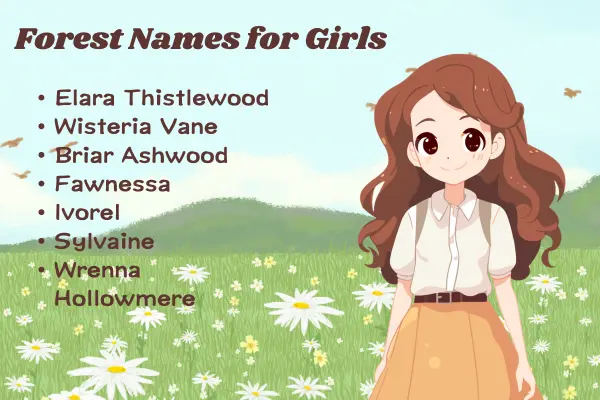
These are forest-inspired character names, ideal for a female protagonist tied to nature, an elf, a fae, a druid, or any character whose identity is woven into the woods. Rather than naming the forest itself, these give the forest’s personality to a person.
- Elara Thistlewood
- Wisteria Vane
- Briar Ashwood
- Fawnessa
- Ivorel
- Sylvaine
- Wrenna Hollowmere
- Marigold Fen
- Thalindra
- Larkspur Wilde
- Rosalind Thornbrook
- Amara Woodrue
- Celestine Moss
- Hazel Windmere
- Isolde Fernwhisper
If you want something that reads as cute rather than elegant, shorten these to a single word, such as Wrenna, Fawnessa, or Marigold. They keep the forest feeling without the extra weight of a surname.
Forest Names for Boys
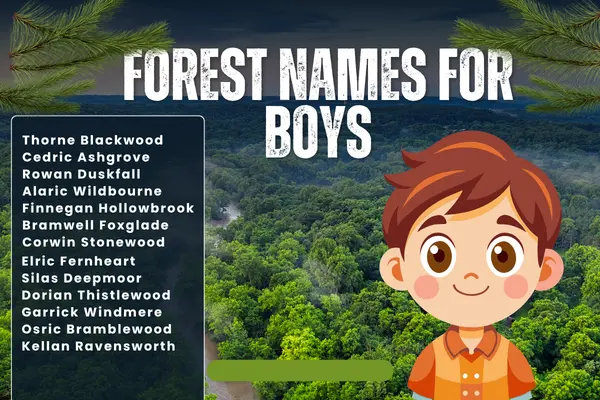
The same idea applies here, built for male characters with a strong connection to the wilderness, whether that means a ranger, a woodcutter’s son, or a half-elf raised in the deep woods.
- Thorne Blackwood
- Cedric Ashgrove
- Rowan Duskfall
- Alaric Wildbourne
- Finnegan Hollowbrook
- Bramwell Foxglade
- Corwin Stonewood
- Elric Fernheart
- Silas Deepmoor
- Dorian Thistlewood
- Garrick Windmere
- Osric Bramblewood
- Kellan Ravensworth
- Tobias Hollowfen
- Wilder Ashcombe
For a name that feels unique rather than common, avoid pairing a very familiar first name with a very familiar forest surname. Something like Osric Bramblewood stands out far more than Jack Woods.
Cool & Gender-Neutral Forest Names
Not every character or forest needs a gendered name. These work equally well for any character, or for a forest that you want to feel modern and understated rather than classically fantastical.
- Sage Hollowmere
- River Ashwood
- Wren Duskfall
- Ash Fernbrook
- Storm Wildwood
- Fox Hollowvane
- Reed Mossgrave
- Sparrow Windmere
- Briar Stonewood
- Wilder Thornfen
- Onyx Woodrue
- Vale Ravencrest
Woodland & Nature-Inspired Forest Names
Sometimes you do not need “forest” in the name at all. Words like wood, grove, glade, thicket, hollow, wilderness, copse, and timberland can all stand in for it, and switching between them keeps a series of place names from feeling repetitive.
- Silverpine Wilderness
- Mossgate Grove
- Fernhollow Thicket
- Oakenshade Glade
- Brackenveil Wood
- Willowmere Copse
- Thistledown Woods
- Cedarfall Wilderness
- Hazelroot Grove
- Birchwhisper Thicket
- Pinecrest Wilderness
- Elmshadow Glade
If your story involves several forests, using different synonyms for each one is a simple way to help readers keep them apart without having to explain anything directly.
Rainforest Names
Rainforests carry a different feeling than temperate woods. They should sound humid, dense, and alive, often with a hint of danger from what might be hiding in the canopy.
- Verdant Canopy
- Emerald Mist Rainforest
- Skyroot Jungle
- Orchid Veil Forest
- Mistfall Canopy
- Junglethorn Wilds
- Sunleaf Rainforest
- Cascadefern Jungle
- Goldmoss Rainforest
- Riverbloom Jungle
A useful trick here is borrowing the feel of real-world rainforest languages without copying an actual place name. Words that evoke mist, canopy, bloom, and river tend to read as tropical even without any direct translation.
DnD Forest Names
Tabletop forests need more than a mood. They usually need a built-in reason for adventurers to go there, whether that is a monster, a faction, or a magical anomaly. Each of these comes with a quick note on how you might use it at the table.
- The Whisperwood — a druid sanctuary where the trees are said to listen
- Ashfall Thicket — cursed ground from an old battle, still smoking after decades
- Sylvan Hollow — a fey-touched grove where time moves strangely
- Ravenmoor Forest — home to a corrupted flock used as scouts by something worse
- Elderglen — an ancient elven forest closed off to outsiders
- The Gloamwood — permanently caught in a magical twilight
- Thornhaven — a bandit stronghold hidden deep in thorny undergrowth
- Mistveil Forest — illusions are common here, and nothing is quite what it looks like
- Deepbriar Wilds — dense, hostile, and home to something large that has never been named
- The Hollow Canopy — treant territory, hostile to anyone who fells a tree
- Wyrmroot Forest — grows in twisted patterns near an old dragon’s lair
- Duskfen — half swamp, half forest, and dangerous at the boundary between the two
- The Petrified Grove — a forest turned to stone by a forgotten curse
- Starfall Woods — meteor fragments embedded in the ground give off strange magic
- Grimtangle Forest — riddled with traps left by a long-dead guardian
Giving your DnD forest a built-in hook like this saves you prep time later, since the name itself already suggests a quest.
How to Create Your Own Forest Name (Free Formula)
If none of the names above feel exactly right, you can build your own in under a minute using this three-part formula:
| Step 1: Adjective / Prefix | Step 2: Forest Element | Step 3: Forest Synonym | Example Generated Name |
| Shadow | Bark | Wilderness | Shadowbark Wilderness |
| Frost | Raven | Thicket | Frostraven Thicket |
| Twilight | Fern | Glade | Twilightfern Glade |
| Iron | Oak | Timberland | Ironoak Timberland |
| Whisper | Bough | Hollow | Whisperbough Hollow |
Combine one word from each list, and you have a working forest name. A few examples this formula might produce:
- Shadowbark Wilderness
- Frostraven Thicket
- Twilightfern Glade
- Ironoak Timberland
- Whisperbough Hollow
You do not need to use all three parts every time. Sometimes two words are enough, like Moonfern Woods or Stormroot Grove. Read the result out loud before you commit to it. If it trips up your tongue, swap one word and try again.
FAQs About Forest Names
What is a good name for a magical forest?
Names that combine something soft or luminous with a gentle forest word tend to work best, such as Moonpetal Grove or Wishwood Hollow. Avoid anything too heavy or ominous if you want the magic to feel welcoming rather than dangerous.
What are some scary forest names?
Blackthorn Hollow, Grimhollow Woods, and Cursed Hollow all create unease without over-explaining themselves. The most effective scary names hint at a threat rather than describing it outright.
What are good DnD forest names?
Look for a name that also suggests why players would want to go there. The Whisperwood, Thornhaven, and Mistveil Forest all work well because the name itself implies a mystery or a danger worth investigating.
What’s a good name for a rainforest in a story?
Words tied to mist, canopy, bloom, and rivers tend to read as tropical, even without borrowing directly from a real-world language. Emerald Mist Rainforest and Skyroot Jungle are both good starting points.
How do you come up with a fantasy forest name?
The fastest method is the three-part formula above: an adjective, a forest element, and a forest synonym. Mix and match until one sounds right for your world, then say it out loud to test how it flows.
Do names that mean “forest” work for fantasy characters?
Yes, and several already carry the meaning built in. Silas and Sylvia both come from the Latin word for forest, and Sylvan and Sylvain follow the same root. These work especially well for characters with a deep connection to the woods, since the name quietly reinforces who they are without needing extra explanation.
Final Thoughts
A forest name is doing more work than most writers give it credit for. It sets a mood before a single word of description appears, and it tells your reader what kind of place they are about to enter. Whether you needed something magical, something unsettling, or something built specifically for your next campaign, you should now have more than enough options to choose from, along with a formula you can return to whenever you need a fresh one.
If you are still building out your world, you may also want to check out our other name generators for characters, kingdoms, and creatures to keep your naming consistent across the whole story.