
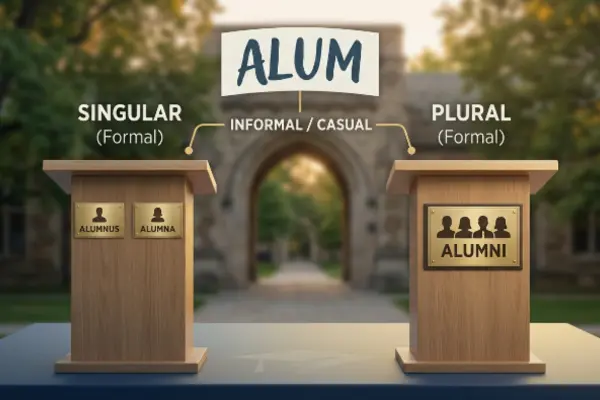
If you’ve ever paused mid-sentence trying to decide between alum vs. alumni, you’re not alone. Even people who graduated with honors trip over this one, and it’s not really their fault. English borrowed these words from Latin and never quite finished adapting them, so we’re left juggling five different forms for what is, at its core, one simple idea: someone who attended a school.
Here’s the short version. Alum is the easy, informal option that works for anyone. Alumni is the plural form. Alumnus and alumna are the formal, gendered singular versions, and alumnae is the formal plural for a group of women. That’s the entire system in one paragraph.
The rest of this guide covers exactly when to use each word, where they came from, the mistakes almost everyone makes at some point, and how to pronounce them with confidence.
What Does “Alum” and “Alumni” Actually Mean?
At the most basic level, an alum is a person who attended or graduated from a particular school, college, or university. It’s short, casual, and doesn’t care about gender a man or a woman can both be described as an alum.
Alumni is simply the plural. If you’re talking about a group of former students, whether they’re all men, all women, or a mix of both, alumni covers it. This is why you’ll see phrases like “Harvard alumni” or “our proud alumni” used to describe an entire graduating class or an entire community of former students, not just one person.
So what’s the difference between alum and alumnus, or alum and alumna? Alumnus and alumna are the more formal, gender-specific versions of the same idea. Alumnus refers to one male graduate, and alumna refers to one female graduate. Alumnae, meanwhile, is the plural used specifically for a group of women.
Technically, none of these words require someone to have graduated. Even attending a school for a period of time, without finishing, is often enough to earn the label. That’s a detail worth its own explanation, and we’ll come back to it a little later.
Alum vs Alumni vs Alumnus vs Alumna vs Alumnae
This is the section to bookmark. Below is a side-by-side breakdown of all five words, including whether each one is singular or plural, which gender it applies to (if any), how formal it is, and an example sentence showing it used correctly.
| Term | Number | Gender | Formality | Example |
| Alum | Singular | Gender-neutral | Informal | “She’s a proud alum of NYU.” |
| Alumnus | Singular | Male (traditional) | Formal | “He is an alumnus of Yale.” |
| Alumna | Singular | Female | Formal | “She is an alumna of Oxford.” |
| Alumni | Plural | Male or mixed group | Formal & informal | “The alumni gathered for reunion weekend.” |
| Alumnae | Plural | Female only | Formal | “The alumnae reconnected at the gala.” |
A few things explain why the table looks this way. Latin nouns like these change their ending depending on gender and number, which is exactly why English speakers get tripped up. Alumnus and alumni share a root, but alumnus is one man and alumni is more than one man, or a mixed-gender group. Alumna and alumnae work the same way for women: alumna is one woman, alumnae is more than one woman.
This raises a common question: is alumni singular or plural? Alumni is always plural. If you’re describing one person, alumni is the wrong word, even though it’s the one most people reach for out of habit. That instinct is understandable, since alumni is by far the most commonly heard of the five terms, but it’s also the source of one of the biggest mistakes on this list, covered in detail below.
One more distinction worth knowing: is alumnus always male, and is alumna always female? Traditionally, yes. But because “alumnus” and “alumni” are also frequently used as gender-neutral defaults in casual speech, especially in American English, you’ll sometimes hear alumnus used loosely to describe anyone, regardless of gender. If you want to stay strictly correct, the male and female distinction above is the standard rule to follow.
When to Use Alum vs. When to Use Alumni
The real question most people are actually asking isn’t “what do these words mean.” It’s “which one should I use right now.” Here’s a practical way to think about it.
Reach for alum when you’re writing casually: a social media bio, an email to a friend, a quick mention in conversation. It’s short, gender-neutral, and nobody will bat an eye. “I’m an alum of State University” reads perfectly naturally in an informal setting.
Switch to alumnus, alumna, alumni, or alumnae when you’re writing something more formal. Resumes, cover letters, official bios, press releases, and academic writing all call for the more precise, traditional forms. If you’re listing your education on a resume, “alumnus of the University of Michigan” reads as more polished than “alum,” which can come across as slightly too casual for that context.
There’s also a regional pattern worth knowing. Alum, as a shortened, informal term, shows up far more often in American English than in British or Canadian English. UK and Canadian writing tends to stick with alumnus, alumna, alumni, and alumnae more consistently, even in less formal contexts. If you’re writing for a UK or Canadian audience, leaning toward the fuller forms is generally the safer choice.
When in doubt, match the formality of the writing around it. A casual newsletter can handle “alum.” A university’s official website copy usually can’t.
Common Mistakes People Make (And How to Avoid Them)
A few errors show up constantly, even in professional writing, so they’re worth calling out directly.
The most common one: “I am an alumni of this school.” This is incorrect, because alumni is plural. A single person can’t be “an alumni” any more than they could be “an students.” The correct versions are “I am an alumnus” if you’re male, “I am an alumna” if you’re female, or simply “I am an alum” if you’d rather sidestep the gender question entirely.
Another frequent mix-up is using alumnae when you mean alumni, or the other way around. Remember that alumnae is strictly for a group of women. If the group includes even one man, alumni is the correct term.
Then there’s a smaller, funnier trap: confusing alumni with aluminum. The two words share a few letters and absolutely nothing else. One is a metal, the other is a graduate, and it happens more often than you’d expect when typing quickly.
Finally, watch out for treating alumnus as if it pluralizes like a regular English word. There’s no such word as “alumnuses.” The only correct plural of alumnus is alumni.
If this whole singular-versus-plural pattern feels unfamiliar, it’s the same kind of confusion that trips people up with other commonly confused word pairs, similar to how Principle vs Principal creates its own kind of mix-up for entirely different reasons.
Where Do These Words Come From? (The Latin Origin of Alumni)
These words didn’t start out as graduation terms at all. They trace back to the Latin verb alere, meaning “to nourish” or “to feed.” An alumnus, in its original sense, was someone who had been nourished, raised, or fostered, much closer to a “foster child” of an institution than simply a former student.
That same root is where alma mater comes from too, a phrase that literally translates to “nourishing mother.” It’s why people still refer to their old school as their alma mater. The two ideas are connected: your alma mater nourished you, and you became its alumnus, alumna, or alum as a result.
English adopted alumnus from Latin sometime in the 1600s, and it took a while longer for the informal “alum” to catch on as everyday shorthand. That shift happened gradually, mostly through casual spoken use rather than any formal decision, which is part of why alum still feels a touch less formal than its Latin relatives.
Do You Have to Graduate to Be an Alumnus?
Here’s a detail that surprises a lot of people: you don’t technically need to graduate to be considered an alumnus, alumna, or alum. If you attended a school for even a semester and then transferred or left before finishing your degree, many institutions still consider you part of their alumni community.
This isn’t universal. Some schools reserve the term strictly for graduates, especially in official or legal contexts like alumni association membership. But in everyday usage, and in how most colleges and universities talk about their communities, attendance alone is usually enough.
If you’re ever unsure whether you personally qualify, the safest approach is to check with the specific school. The general rule, though, leans generous. Showing up and being part of the community counts for more than the diploma itself.
Alumni vs. Graduate: Is There a Difference?
These two words overlap so much that people often use them interchangeably, but there’s a subtle distinction. A graduate is someone who completed their degree or program. An alumnus, alumna, or member of the alumni community can include graduates, but it also includes people who attended without finishing, as covered above.
In practice, “graduate” is the narrower, more specific term, while “alumni” is the broader, community-oriented one. A university might proudly claim someone as an alumnus even if that person left before graduating, but it wouldn’t call them a graduate unless they actually finished. If you want the most accurate word, ask whether the person completed the program. If yes, either word works. If no, alumnus or alum is the more accurate choice.
How to Pronounce Alumni, Alumna, Alumnus, and Alumnae
Even native English speakers hesitate on these out loud, so here’s a quick guide.
Alumnus is pronounced uh-LUM-nus. Alumni, the plural, is pronounced uh-LUM-nye, with that final syllable rhyming with “eye.” Alumna is pronounced uh-LUM-nuh, and alumnae, its plural, is pronounced uh-LUM-nee, rhyming with “bee.”
That last one trips people up the most, since alumnae looks like it should rhyme with alumni, but it doesn’t. A simple way to remember it: alumni ends in an “eye” sound, alumnae ends in an “ee” sound. Say them side by side a few times and the difference sticks fairly quickly.
Frequently Asked Questions
What is the difference between alum and alumni?
Alum is singular and gender-neutral, referring to one former student of any gender. Alumni is plural, referring to more than one former student, whether the group is all men, all women, or mixed. Use alum for one person, alumni for a group.
What does alumni mean exactly?
Alumni refers to a group of people who attended or graduated from the same school, college, or university. It’s the plural form and applies regardless of gender, which makes it the standard word for talking about a graduating class or an entire school community.
Is alumni singular or plural?
Alumni is always plural. Referring to one person as “an alumni” is a common but incorrect usage. For a single person, the correct words are alumnus for a man, alumna for a woman, or alum if you want a gender-neutral option.
What is the proper use of alum vs alumni in professional writing?
In formal or professional contexts, such as resumes, official bios, or academic writing, the fuller forms (alumnus, alumna, alumni, alumnae) are generally preferred. Alum fits better in casual writing, like social media or everyday conversation, where a more relaxed tone makes sense.
What does alumni association mean?
An alumni association is an organized group, usually run by or affiliated with a school, that connects former students after graduation. These associations often host reunions, fundraising events, and networking opportunities for the wider alumni community.
Can “alumnus” be used for someone who worked at a company rather than attended a school?
Yes. Outside of education, alumnus and alumni are sometimes used loosely to describe former employees of a company or organization, as in “she’s an alumna of that consulting firm.” It’s a figurative extension of the original meaning, but a widely accepted one.
How do you know if you should use alumnus or alumna?
It comes down to gender. Alumnus is the traditional term for a male graduate, and alumna is the traditional term for a female graduate. If you’re unsure or want a gender-neutral option, alum works for either.
The Bottom Line
Five words, one shared root, and hopefully zero confusion left. The pattern really does come down to two questions: how many people are you talking about, and how formal does the writing need to be? Answer those two questions, and the right word almost picks itself.
For a single person in casual writing, alum works every time, and nobody will think twice about it. For a single person in something more formal, like a resume or an official bio, alumnus for a man or alumna for a woman is the sharper, more traditional choice. For a group, alumni covers nearly every situation, unless you’re specifically describing a group of women only, in which case alumnae is the precise term.
The mistake to remember above all the others is the “I am an alumni” trap. Since alumni is plural, it can never describe just one person, no matter how natural it might sound in the moment. Catching that one habit alone will put your writing ahead of a lot of people who never learned the distinction.
None of this needs to feel intimidating the next time you’re drafting an email to your old school, updating your professional profile, or writing a bio for an event. Pick the word that matches your audience and your formality, and move on with confidence.
If mixing up similar-looking word pairs is a pattern for you, you’re not alone, and it’s worth building the habit of double-checking the ones that trip you up most often. Word pairs like Alot vs A Lot cause just as much hesitation as alum versus alumni, and getting comfortable with a few of these commonly confused words tends to make the rest easier to catch on your own. Bookmark this page, and the next time someone asks whether they’re an alum or an alumnus, you’ll already know the answer.